Car registration in Victoria typically costs $800 to $1,1200 per year for a standard passenger vehicle, including registration and Transport Accident Commission (TAC) insurance.
Key Takeaways
- Car registration in Victoria costs around $800 to $1,200 per year for most passenger vehicles.
- The highest proportion of the cost is the Transport Accident Commission (TAC).
- Metro areas have a higher accident risk, and thus drivers pay more compared to areas in the region.
- The type of vehicle and its use (private or commercial) will influence the final price.
- Purchasing a vehicle incurs additional initial expenses such as motor vehicle duty and transfer fee.
- The rego is higher in Victoria than in QLD and WA, but tends to be similar or a little lower than NSW in general.
- The cost of 12 months advance payment is normally more affordable than the short-term registration.
- Rego in Victoria also covers injury insurance and not a full coverage of car insurance.
- Knowing cost breakdown will make you better in budgeting and prevent surprises.
- Never look at the cost of purchasing the car only, but the total cost of ownership.
Car registration in Victoria is not a single fee but rather a combination of various elements such as registration, TAC, and insurance. Budgeting can be achieved by understanding the complete breakdown of the cost whether you are buying a new car or renewing your rego.
This guide will tell you precisely how much it costs to register a car in Victoria, how the price is influenced and how you can save money.
What Is Car Registration in Victoria?
Car registration (commonly called “rego”) is mandatory in Victoria. It allows your vehicle to be legally driven on public roads.
The registration fee covers:
- Vehicle registration fee
- Transport Accident Charge (TAC)
- Number plate fee (for new registrations)
- Motor vehicle duty (if buying a car)
Why Is Car Registration Important?
Car registration serves several key purposes:
- Legal compliance – Confirms that your vehicle is registered and that it has permission to be on the road.
- Safety assurance – Refers to the assurance that vehicles are of minimum safety standards.
- Financial protection – Covers costs of injury by mandatory insurance.
- Identification – Helps officers monitor vehicles through number plates.
In simple terms, rego is what will make your car road legal in Victoria.
Average Car Registration Cost in Victoria (2026)
On average, car registration in Victoria costs between:
$800 to $1,200 per year
This is however just an estimate. The price you will actually pay can be very different based on factors like where you are, the type of vehicle and the usage of the vehicle.
Registration in Victoria is not a fixed cost, but a calculation of a mixture of government fees and mandatory insurance fees. This is the reason why two drivers may have similar cars yet pay different rego.
Why Costs Vary So Much
The biggest reason for price variation is the Transport Accident Charge (TAC), which changes based on:
- Your residential zone (metro vs regional)
- The risk level associated with your vehicle
- Historical accident data in your area
For example, the charge to drivers in metropolitan Melbourne tends to be higher than the one in rural regions because of the increased traffic congestion and the possibility of accidents.
Example Breakdown (Typical Passenger Car)
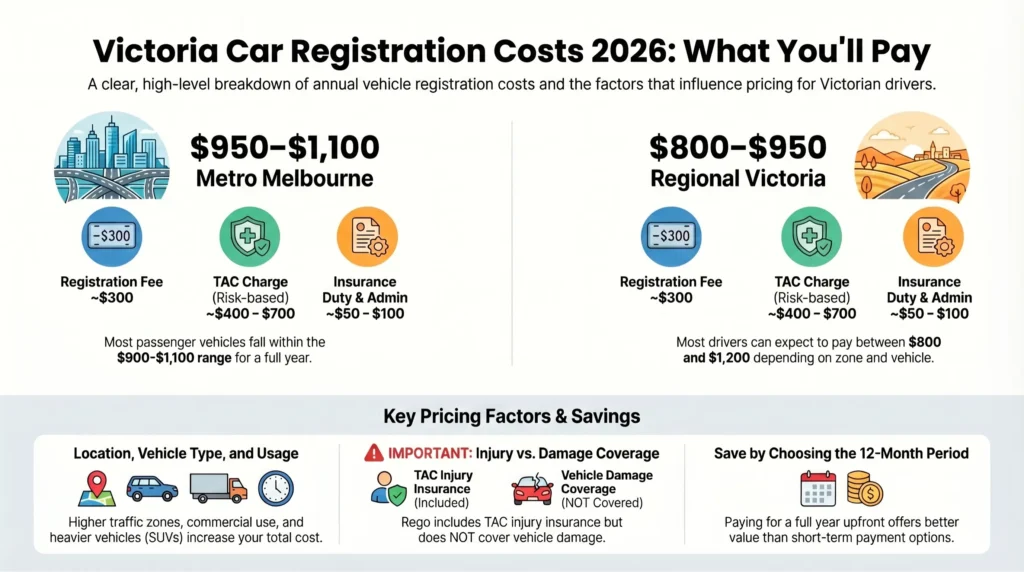
Here’s a realistic cost breakdown for a standard passenger vehicle:
- Registration fee: ~$300
- TAC charge: ~$400–$700
- Insurance duty & admin fees: ~$50–$100
Total: Around $850–$1,100 annually
Understanding Each Cost Component
Registration Fee
This is the set base price to maintain your vehicle legally registered. It tends to remain the same in most vehicles.
TAC Charge
This is the largest portion of your rego cost. It finances injury compensation via the road safety system in Victoria. It is the most variable since it is risk-based.
Insurance Duty & Admin Fees
These are lesser government fees that are imposed on top of TAC and registration. Although they are not very significant, they add to the overall price.
Metro vs Regional Cost Example
To give you a clearer idea:
- Melbourne driver: ~$950–$1,100/year
- Regional Victoria driver: ~$800–$950/year
This difference is mainly due to lower TAC charges in rural areas.
Important Note for New Car Owners
When you are first registering a car (or changing ownership), you will have a greater initial cost than the annual estimate above. This is due to extra expenses such as:
- Motor vehicle duty
- Roadworthy certificate
- Transfer fees
are added on top of the standard rego fee.
Key Insight
While the average cost sits between $800 and $1,200, most drivers fall closer to the $900–$1,100 range annually.
Understanding this breakdown helps you:
- Plan your yearly vehicle expenses
- Avoid surprises during renewal
- Compare true ownership costs before buying a car
Key Factors That Affect Car Registration Cost in Victoria
Not all people pay the same price to car registration in Victoria. Two individuals might be having the same car but pay differently. This is due to the fact that rego pricing is affected by various critical factors that dictate risk, usage and location.
Knowing these factors will assist you to estimate your real cost better- and even how to decrease it.
1. Location (Metro vs Regional Zones)
One of the biggest factors affecting your registration cost is where you live.
Victoria uses a zonal system set by Transport Accident Commission, which divides areas based on accident risk.
How It Works:
- Metropolitan areas (e.g., Melbourne)
- Higher traffic volume
- More accidents
- Higher TAC charges
- Outer metro & regional areas
- Less traffic
- Lower accident rates
- Lower rego costs
Example:
A driver in central Melbourne can pay more than 1050/year whereas in regional Victoria the same kind of car can cost a motorist nearer to 850/year.
This difference is primarily due to the TAC (insurance risk) component.
2. Vehicle Type & Category
The type of vehicle you drive also plays a major role in determining registration costs.
Common Categories:
- Passenger vehicles (sedans, hatchbacks)
→ Standard registration cost - SUVs & 4WDs
→ Slightly higher due to size and weight - Commercial vehicles (utes, vans)
→ Higher fees due to business usage and increased road exposure - Motorcycles
→ Lower registration cost
Heavier and more frequently used vehicles are generally considered higher risk, which increases TAC charges.
3. Vehicle Usage (Private vs Business)
How you use your vehicle can also impact your rego cost.
- Private use
→ Lower cost (standard usage) - Business or commercial use
→ Higher cost due to:- Increased time on the road
- Greater exposure to accidents
For example, a delivery van or tradie ute will usually cost more to register than a personal sedan.
4. Vehicle Value (Motor Vehicle Duty)
If you’re buying or transferring a vehicle, its market value directly affects your upfront cost.
This is because of motor vehicle duty, a government tax applied during ownership transfer.
Example:
- $20,000 car → Lower duty
- $50,000 car → Significantly higher duty
- $80,000+ car → Much higher upfront cost
While this is a one-time payment, it can add thousands of dollars to your total cost.
5. Registration Period
Victoria allows flexible rego payment durations:
- 3 months
- 6 months
- 12 months
Cost Impact:
- 12 months → Best value overall
- Short-term (3 or 6 months) → Slightly more expensive per period
Shorter durations are useful for cash flow, but they increase total yearly cost due to extra admin fees.
6. Vehicle Age & Condition
While age doesn’t directly change your base rego fee, it can affect additional costs:
- Older cars are more likely to need repairs
- May require a roadworthy certificate during sale/transfer
- Higher chance of maintenance expenses
This doesn’t always increase rego itself, but it increases the total cost of staying road legal.
7. Number Plate Type (Optional Factor)
If you’re getting new plates, the type you choose can affect your cost:
- Standard plates → Low cost
- Custom/personalised plates → Higher upfront and ongoing fees
This is optional but can add noticeable cost if you prefer custom branding.
Key Insight
The biggest factors that influence your rego cost are:
✔️ Location (metro vs regional)
✔️ Vehicle type (car, SUV, commercial)
✔️ Usage (personal vs business)
✔️ Vehicle value (for new purchases)
Pro Tip
When purchasing a car, total ownership cost should always be considered and not the purchase price only. The rego costs of two cars of the same price can vary greatly depending on these factors.
Additional Costs to Consider
When registering a car for the first time, you may also pay:
- Roadworthy Certificate (RWC): ~$150–$250
- Number plates: ~$40–$100
- Transfer fee: ~$40
Renewal vs New Registration Cost
Renewal (Existing Car)
- No roadworthy required (unless requested)
- Lower overall cost
~$800–$1,100/year
New Registration (Used Car Purchase)
- Includes transfer fee + RWC
Can exceed $1,200–$2,000 total
How to Save Money on Car Registration
Here are some practical tips:
✔️ Choose Rural Registration (If Eligible)
Living in regional areas reduces TAC charges significantly.
✔️ Pay Annually
Avoid extra admin fees from shorter renewal periods.
✔️ Buy Fuel-Efficient Cars
Lower-risk vehicles may reduce TAC-related costs.
✔️ Compare Before Buying
Check rego costs before purchasing a vehicle—especially SUVs or high-value cars.
Car Registration Cost Comparison (Australia – 2026)
| State | Average Annual Cost (Passenger Car) | What’s Included | Notes |
| Victoria (VIC) | $850 – $1,100 | Rego + TAC (injury insurance) | Higher due to bundled insurance |
| New South Wales (NSW) | $900 – $1,300+ | Rego + CTP (separate) + inspection | Can be higher overall depending on vehicle weight |
| Queensland (QLD) | $840 – $1,050 | Rego + traffic fee + CTP | More structured pricing based on engine size |
| Western Australia (WA) | $700 – $900 | Rego (CTP included but simpler) | Generally lower due to simpler system |
Conclusion
Registration of cars in Victoria is a vital component of owning a vehicle, as it makes sure that your car is legal and insured against injury by the Transport Accident Commission (TAC). It is estimated to cost an average of 800 to 1,200 annually on a typical passenger car and this depends on the location, type of vehicle, and usage.
Although the rego is a little bit higher than other states such as Queensland and Western Australia, it offers a complete coverage of injuries as part of your registration which is a relief. Knowing the complete cost breakdown, such as motor vehicle duty, number plates, and TAC charges, will assist you to budget and prevent surprises.
With proper planning and selection of the appropriate vehicle and registration term you will be able to keep costs under control and still be well within the Victorian road legislation.