Vehicle inspections are only required in specific situations in the ACT, including interstate transfers, unregistered vehicles, heavy vehicles and vehicles with defects. The inspection inspects important safety equipment such as lights, steering, tyres, suspension, brakes and structure. Any problems that are identified should be fixed before the car can be registered in Canberra.
Key Takeaways
- Not all vehicles in the ACT require an inspection—only specific cases do.
- Inspections are mainly needed for interstate transfers, unregistered vehicles, heavy vehicles, and defected vehicles.
- The inspection focuses on essential safety areas like brakes, tyres, suspension, lights, steering, and structural integrity.
- Any identified defects must be repaired before the vehicle can be registered.
- Passing the inspection is necessary to ensure the vehicle is safe and legally compliant for Canberra roads.
Whether you’re registering your first vehicle or renewing your current one, this guide will help you navigate the process easily and ensure you have all the necessary paperwork and inspections sorted out before you hit the road. From the paperwork to the inspections and the fees, this guide will cover everything you need to know about registering your car in Canberra so you can do so with ease and confidence.
Why Vehicle Registration Matters in Canberra
It is a legal requirement to register your vehicle before using it on Canberra roads. Registration will tell the government that your car is safe for use in Australia and can help identify vehicles and owners.
Driving an unregistered vehicle in the ACT can lead to:
- Heavy fines
- Insurance complications
- Vehicle impoundment in serious cases
- Legal penalties after an accident
It also covers compulsory third-party (CTP) insurance, which helps drivers with the financial burden if someone gets injured in a road accident.
Types of Vehicle Registration in Canberra
The ACT has a number of vehicle registration services for you to choose from depending on your situation. Knowing what type of registration your vehicle is eligible for can help make the process easier and ensure that you comply with all of the legal requirements before hitting the Canberra roads.
New Vehicle Registration
New vehicle registration is for brand new vehicles bought from licensed car dealers. In most cases, the dealership will do the registration for the buyer, including the submission of paperwork and the compulsory third party (CTP) insurance.
Buyers usually receive:
- ACT number plates
- Registration certificate
- CTP insurance confirmation
Prior to departing the dealership, it is crucial to ensure that the registration process is completed and that the ownership information is correct.
Used Vehicle Transfer
If a second hand car is being bought or sold in Canberra, the registration will need to be transferred to the new owner. This procedure helps to update the vehicle’s legal ownership documentation with ACT authorities.
The buyer typically needs:
- Signed transfer documents
- Proof of identity
- Payment of transfer fees
- Current registration details
It is also important for the seller to inform the relevant authority after the sale so as to prevent future fines or traffic violations associated with the car.
Interstate Registration Transfer
If you move to Canberra from a different state or territory, you need to register your car in Canberra within the specified time period.
This process may involve:
- Vehicle identity inspection
- Surrendering interstate number plates
- Providing ACT proof of residency
- Obtaining ACT CTP insurance
Interstate transfer helps ensure that vehicles meet ACT road and safety requirements.
Unregistered Vehicle Registration
Unregistered vehicles or vehicles that have not been on the road for a long time must obtain unregistered vehicle registration prior to being able to legally drive on the road.
In many cases, owners must complete:
- A vehicle inspection
- Safety compliance checks
- Proof of ownership verification
The penalties for driving an unregistered vehicle in the ACT without a licence are serious, so it is important to get the vehicle registered before driving it on public roads.
Business or Fleet Registration
Commercial or fleet registration services are available for businesses that run more than one vehicle. This option is popular among:
- Delivery companies
- Tradespeople
- Corporate fleets
- Transport operators
By streamlining the fleet registration process, businesses can more easily manage renewals, records, and compliance requirements. Depending on vehicle size, weight or operational use, commercial vehicles might also have other obligations.
Documents Required for Vehicle Registration in Canberra
In Canberra, it is important to have all the documents necessary for vehicle registration prepared before starting the process. One of the most frequent causes of delays is missing documents, particularly when buying/selling a car or registering a car from another state.
It will help in a smooth and quick registration process to have proper and updated documentation.
1. Proof of Identity
Valid identification will be required of all applicants to establish their identity. Your ID card must be identical with the ownership and registration papers.
Accepted forms of identification may include:
- Australian driver licence
- Passport
- ACT proof of age card
In certain cases, further identification may be required, such as for business registrations or interstate transfers.
2. Proof of ACT Residency
In order to register a vehicle in the ACT, you will need to provide proof that you are a resident of Canberra or elsewhere in ACT.
Commonly accepted proof of residency documents include:
- Utility bill
- Rental agreement or lease
- Bank statement
- Government correspondence
Documents should generally display your full name and current ACT residential address.
3. Vehicle Ownership Documents
Vehicle registration and transfer require proof of vehicle ownership. These are documents that will establish that you own the car legitimately and that you are entitled to register the vehicle.
Ownership documents may include:
- Sales receipt
- Tax invoice
- Vehicle transfer papers
- Previous registration certificate
- Finance payout documentation (if applicable)
Ensure that any paperwork of ownership has the correct details on it, including the Vehicle Identification Number (VIN).
4. Roadworthy or Inspection Certificate
Some vehicles must go through a safety inspection prior to being registered in Canberra. This helps to ensure that the vehicle complies with the ACT road safety standard.
Inspections are commonly required for:
- Interstate vehicles
- Previously unregistered vehicles
- Defect-cleared vehicles
- Certain commercial vehicles
Inspections are usually performed on the major safety systems like brakes, tyres, steering, suspension and lights.
5. Compulsory Third Party (CTP) Insurance
All registered vehicles in the ACT must have CTP insurance. This type of insurance policy is designed to help you receive compensation from an insurance company if a person is injured when operating your car under these circumstances.
Before registration approval, vehicle owners must:
- Choose an approved CTP insurer
- Purchase a valid CTP policy
- Ensure insurance details match registration records
Without active CTP insurance, registration cannot be completed legally in Canberra.
Helpful Tip Before Applying
Before visiting a service centre or submitting your application online, double-check that:
- All documents are current
- Names and addresses match across paperwork
- Vehicle details are accurate
- Inspection certificates are still valid
Preparing your documents properly can help avoid unnecessary delays and make the Canberra vehicle registration process far more efficient.
Step-by-Step Vehicle Registration Process in Canberra
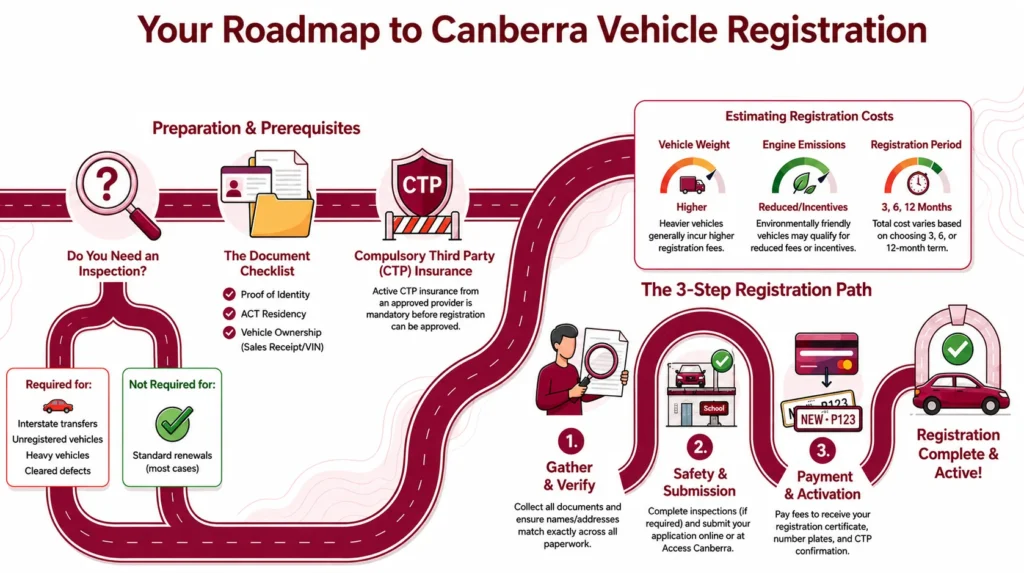
The process for registering a vehicle in Canberra is designed to ensure all vehicles comply with safety, insurance and legal requirements. If you are registering a new car, transferring ownership, or importing a vehicle from interstate, here are some steps to help you go through the process smoothly.
Step 1: Gather Your Documents
Gather all the paperwork needed before you start the application. Preparation will help to minimize delays during processing.
You will typically need:
- Proof of identity
- Proof of ACT residency
- Vehicle ownership documents
- Any required inspection certificates
Step 2: Complete Vehicle Inspection (If Required)
To register a vehicle in the ACT, some vehicles are required to have a roadworthiness inspection. This is particularly important for:
- Vehicles imported from another state or territory
- Unregistered vehicles
- Vehicles that have been previously defected or off the road for a long time
The inspection has to be carried out at an approved inspection station and verifies that your vehicle complies with minimum safety requirements for operating on Canberra roads.
Step 3: Obtain CTP Insurance
Compulsory Third Party (CTP) insurance is required from an approved CTP insurance provider in the ACT before you register your vehicle.
If you have an accident that results in injuries, CTP insurance will have compensation coverage. You can’t get a registration without valid CTP insurance.
Step 4: Submit Your Application
When your documents, inspection (if applicable), and insurance are completed, you can register your application in one of the following ways:
- Online application (where eligible)
- In person at an Access Canberra Service Centre
- Through an authorised dealership (for new vehicles)
Make sure all details are accurate to avoid processing delays.
Step 5: Pay Registration Fees
Once you have applied you have to pay the necessary registration fees. The overall cost is determined by a number of factors, such as:
- Type of vehicle
- Vehicle weight
- Engine emissions category
- Length of registration period (e.g., 3, 6, or 12 months)
Additional fees may apply for inspections or transfers.
Step 6: Receive Registration Confirmation
Your vehicle registration is activated once your application is approved and payment is made. At this point you will be given:
- Official registration certificate
- ACT number plates (if applicable)
- Confirmation of CTP insurance coverage
From this point, your vehicle is legally allowed to be driven on Canberra roads
Vehicle Inspection Requirements in the ACT
A roadworthiness inspection is not required for all vehicles in Canberra prior to registration. But there are certain instances where inspections are required to make sure that the vehicle meets ACT safety standards before it can hit the road.
Knowing when to have an inspection can help ensure you do not have unnecessary delays in the registration process.
When a Vehicle Inspection Is Required
A vehicle inspection is typically required for:
- Interstate transfers – when bringing a vehicle from another Australian state or territory
- Unregistered vehicles – vehicles that have not been registered or have expired registration
- Heavy vehicles – commercial or larger vehicles that fall under additional safety regulations
- Vehicles with previous defects – vehicles that have been issued defect notices and need clearance
In these cases, the inspection confirms that the vehicle is safe, compliant, and suitable for use on ACT roads.
What the Inspection Covers
A roadworthiness inspection is a detailed safety check carried out at an authorised inspection station. It emphasizes certain elements that impact the safety and performance of the vehicle.
Inspectors typically assess:
- Braking system
- Tyres and tread condition
- Suspension system
- Lights and electrical systems
- Steering components
- Structural integrity of the vehicle
Each area is checked to ensure the vehicle meets minimum safety requirements set by ACT regulations.
If Your Vehicle Fails the Inspection
The car will not be registered if any faults or safety concerns are discovered during the test.
In such cases:
- You will receive a list of required repairs
- The issues must be fixed by a qualified mechanic
- The vehicle must be re-inspected if necessary
Only after all defects are resolved will the registration process proceed.
Registration Costs in Canberra
Registration costs in Canberra depend on several factors:
| Fee Type | Estimated Cost |
| Registration Fee | Varies by vehicle |
| CTP Insurance | Based on insurer |
| Inspection Fee | Additional if required |
| Transfer Fee | Applies to ownership transfers |
Environmentally friendly vehicles may qualify for reduced fees or incentives in some cases.
How Long Does Registration Take?
Processing time depends on the type of registration.
- Online renewals are often processed quickly
- Interstate transfers may take longer due to inspections
- Missing documents can delay approval
Most standard registrations can be completed within a few business days if all paperwork is correct.
Common Mistakes to Avoid
Many Canberra drivers experience delays because of small errors. Avoid these common mistakes:
- Submitting incomplete documents
- Forgetting proof of ACT residency
- Letting registration expire
- Ignoring inspection requirements
- Using incorrect ownership details
Double-checking paperwork beforehand can save time and frustration.
Tips for a Smooth Registration Experience
To make the process easier:
- Book inspections early
- Keep digital copies of documents
- Compare CTP insurance providers
- Renew registration before expiry
- Verify VIN and engine numbers carefully
If purchasing a used vehicle, confirm there is no outstanding finance attached to the car before transferring ownership.
Interstate Vehicle Transfers to Canberra
Interstate Vehicle Transfers to Canberra are available.Interstate Vehicle Transfers to Canberra is offered.
You may need:
- Previous registration papers
- ACT address proof
- Vehicle inspection certificate
- New ACT number plates
Generally, ACT registration laws apply to anyone who has recently moved to Canberra from another state, and will require your registration to be transferred within a certain time frame of your moving to Canberra.
For any other information, you can check the Canberra Official site.
FAQs
Final Thoughts
You don’t have to get caught out in the process of registering your car in Canberra when you know what you need to do and have all your documents ready. You can follow the correct steps to have the vehicle registration process as smooth as possible, whether it’s for a new car, a transfer of ownership or interstate registration.
You are legally protected, and your vehicle is roadworthy on Canberra roads, by adherence to the ACT registration rules.