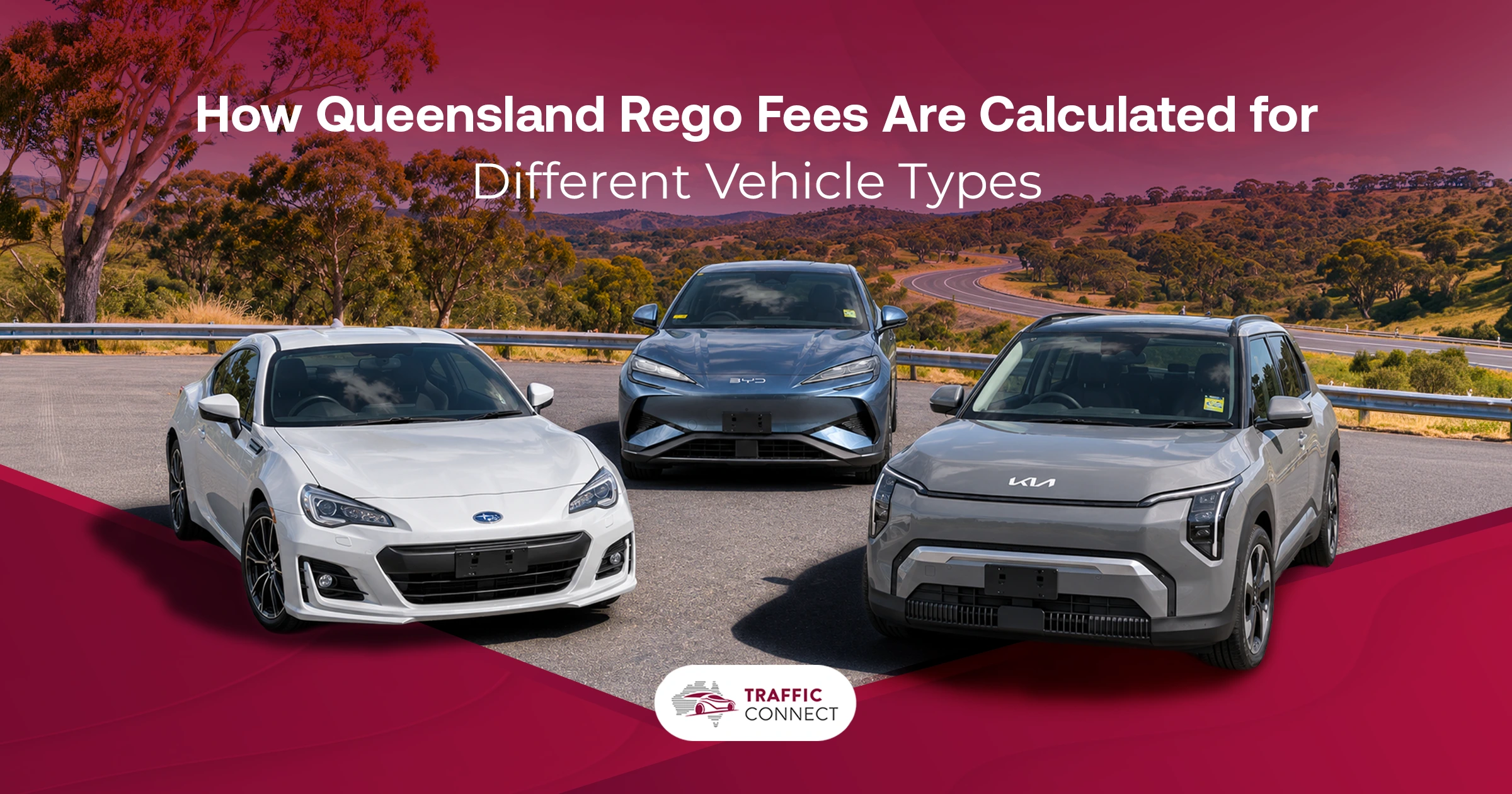
Vehicle registration in Queensland requires more than just paying a normal registration fee. The cumulative cost will vary with the car, engine setup, weight of the car, registration period and compulsory third party (CTP) insurance premium.
If you are buying a new or used passenger car, motorcycle, ute, trailer, caravan or heavy commercial vehicle (HCV), you will need to know how Queensland registers vehicles so you can plan accordingly and not get any nasty surprises.
Queensland Department of Transport and Main Roads (TMR) is responsible for vehicle registration and the registration charges that must be paid. In contrast to some other states in Australia, Queensland charges registration fees for most light motor vehicles according to the number of engine cylinders.
A different system is used in the case of heavy vehicles with different vehicle types and axle configurations.
In this guide, we will look at how Queensland rego fees are determined for various types of vehicles, what they include and ways you can estimate your registration costs.
Key Takeaways
- Queensland vehicle registration costs depend on the vehicle type and applicable registration category.
- Light motor vehicle registration fees are calculated according to engine cylinder groups.
- Electric and steam-powered vehicles fall into the 1–3 cylinder fee category for light vehicle registration.
- Motorcycles have a separate registration fee structure.
- Heavy vehicle registration charges are based on nationally regulated vehicle classifications and axle configurations.
- Registration costs generally include a registration fee, traffic improvement fee, and CTP insurance premium for light vehicles.
- CTP insurance premiums can vary depending on the insurer and vehicle category.
- Shorter registration periods may involve an additional processing surcharge.
- Eligible concession card holders may qualify for reduced registration fees.
- Queensland Government provides an online registration quote tool to estimate costs for different vehicles.
Why Do Queensland Rego Fees Differ Between Vehicle Types?
The cost of vehicle registration varies between different vehicles in Queensland. Registration procedures and fees vary depending on the category of the vehicle.
A small passenger vehicle, a motorcycle and a commercial truck are not all equal when it comes to registration and road-related costs.
There are multiple ways of calculating the amount in Queensland for each vehicle category.
Most light motor vehicles will have a registration fee based on the number of engine cylinders. Heavy vehicles calculations take into account vehicle class, and also number of axles.
Additional expenses such as CTP insurance, traffic improvement fees and any applicable concessions also impact the final price.
It’s critical to grasp the distinctions at the time of registration of a new vehicle or renewal of a current registration.
What Are the Main Components of Queensland Vehicle Registration Fees?
For most light vehicles, the total registration cost consists of three main components.
1. Vehicle Registration Fee
The government fee for registering a vehicle is its main fee, known as the vehicle registration fee.
The amount will vary according to the type of vehicle and its fee group.
The engine cylinder configuration is used to determine the registration fee category for light motor vehicles.
2. Traffic Improvement Fee
Another part of the Queensland vehicle registration fee is the traffic improvement fee.
It is collected by the Department of Transport and Main Roads and is used for road construction and maintenance throughout the State.
The amount is dependent on the vehicle category. The amount of the traffic improvement fee, for instance, varies between motorcycles and regular private passenger cars.
3. Compulsory Third Party (CTP) Insurance
Most vehicles registered in Queensland have to carry CTP insurance as a condition of their registration.
It offers coverage for certain personal injury causes related to car accidents.
The insurance premiums for CTP insurance are determined by the authorised insurance company and may differ between insurance companies and insurance classes.
Vehicle owners in Queensland are able to compare the various CTP insurance companies that offer coverage during the registration or renewal of their motor vehicles.
The three components all contribute to a significant part of the total registration fee for a light vehicle.
How Are Queensland Registration Fees Calculated for Different Vehicle Types?
Queensland follows different registration fee structures for different vehicle categories.
Let’s look at how the calculation works for common vehicle types.
1. Passenger Cars and Light Motor Vehicles
For most light passenger vehicles, Queensland calculates registration fees based on the number of engine cylinders.
Vehicles are grouped into five categories:
- 1 to 3 cylinders, including electric and steam-powered vehicles.
- 4 cylinders.
- 5 or 6 cylinders.
- 7 or 8 cylinders.
- 9 to 12 cylinders.
The more cylinders a vehicle has, the higher registration costs are likely to be.
For instance, a four cylinder passenger car would be a lower registration fee category than an eight cylinder or six cylinder car.
Electric vehicles, which do not include any combustion engines, fall into the category of registration fee 1–3 cylinders.
2. Motorcycles
Motorcycles have a separate registration fee structure in Queensland.
Their registration costs include:
- Motorcycle registration fee.
- Motorcycle traffic improvement fee.
- Applicable CTP insurance premium.
The motorcycle classification for insurance and other factors determine the CTP premium.
For instance, motorcycle registration with a pillion passenger seat or sidecar would be registered under a different CTP insurance class than a motorcycle without a pillion seat or sidecar.
When getting a quote for motorcycle registration, motorcycle owners should verify the information and category of their motorcycle on the details.
3. Light Commercial Vehicles
Light commercial vehicles (LCVs) are normally registered under the light vehicle system up until a maximum gross vehicle mass (GVM) of 4.5 tonnes.
Registration fees vary by engine cylinder class, traffic improvement fee and the CTP premium.
For instance, the registration fee for a four-cylinder commercial ute, such as a pickup, can be different than that of a six-cylinder vehicle.
Different insurance classes may also apply depending on how it’s used or registered.
4. Trailers and Caravans
The registration of trailers and caravans is different to that of motor vehicles.
Their registration fees are based on the category of their trailer and registration fees.
Trailers and caravans are not usually covered by a standard CTP insurance policy, as is the case with most motor vehicles.
Some aspects of their weight and classification may impact upon registration and inspection requirements.
Typically, trailers where the aggregate trailer mass (ATM) is in the range of 750kg to 4,500kg will need a safety certificate for transfer of registration to a new owner or when registered in Queensland under certain circumstances.
The heavy vehicle registration charging system is used for heavy trailers with an ATM of more than 4.5 tonnes.
5. Heavy Vehicles and Trucks
The registration fees for heavy vehicles are different to those of normal passenger vehicles.
A heavy motor vehicle is a vehicle with a GVM in Queensland of more than 4.5 tonnes. Heavy trailers refer to trailers that have an ATM rating over 4.5 tonnes.
Their registration charges are nationally regulated and depend on factors such as:
- Vehicle classification.
- Number of axles.
- Vehicle configuration.
- Applicable heavy vehicle charging category.
For example, a rigid truck, prime mover, road train, and heavy trailer can have significantly different registration charges.
Heavy vehicle registration charges consist of two main components:
- Road use component: Contributes towards the cost of road infrastructure used by heavy vehicles.
- Regulatory component: Helps fund the operation of the National Heavy Vehicle Regulator (NHVR).
Other costs, such as CTP insurance and relevant administration fees also apply.
It’s important for commercial vehicle operators to review the appropriate heavy vehicle charging category to calculate their annual registration costs.
Queensland Rego Fee Examples for 2026–27
Registration costs vary and are published for common private-use vehicles, here are a few examples:
The following rates apply for a 12-month registration period and are subject to the changes in the published fee schedule from 1 October 2026. This applies to vehicles of up to 4-tonnes.
| Vehicle category | Registration fee | Traffic improvement fee | Estimated CTP | Estimated total |
| 1–3 cylinders / Electric | $303.10 | $67.25 | 411.80–427.80 | 782.15–798.15 |
| 4 cylinders | $385.45 | $67.25 | 411.80–427.80 | 864.50–880.50 |
| 5–6 cylinders | $610.30 | $67.25 | 411.80–427.80 | 1,089.35–1,105.35 |
| 7–8 cylinders | $854.70 | $67.25 | 411.80–427.80 | 1,333.75–1,349.75 |
| 9–12 cylinders | $1,002.35 | $67.25 | 411.80–427.80 | 1,481.40–1,497.40 |
| Motorcycle | $145.60 | $73.00 | $443.60 | $662.20 |
These are only examples of future registration fees, and not “personal” registration quotes. Motorcycle classifications are provided as examples only and the CTP premiums may differ between insurers.
These numbers could also vary by commercial and concession usage, other vehicle classes, and registration periods.
Use the official Queensland registration quote service for the most accurate quote.
What Factors Can Affect Your Total Registration Cost?
Although vehicle type is one of the main factors, several other considerations can influence the final amount payable.
Engine Cylinder Configuration
The number of cylinders of a light motor vehicle determines the registration fee group for most light motor vehicles.
The number of cylinders is related to increased registration fees.
For this calculation, the lowest cylinder group includes electric and steam powered vehicles.
Vehicle Weight and Classification
The weight of vehicles is especially relevant for heavy vehicles.
A heavy motor vehicle is normally a vehicle with a GVM weight of more than 4.5 tonnes, whilst a heavy trailer will be over 4.5 tonnes ATM.
The registration charges are based on the relevant national heavy vehicle category and axle configuration.
CTP Insurance Provider
Most motor vehicles are registered with CTP insurance.
The premium is not the same for all insurance companies, however.
When comparing authorised CTP providers you can get an idea of the premiums that are available before you renew your registration.
Registration Period
Queensland has various registration periods for the different categories of vehicles.
Alternatively, if it is a shorter registration period than 12 months, an extra processing fee could be charged.
This surcharge is to defray administrative expenses of maintaining the vehicle register and sending out additional notices.
Concession Eligibility
If eligible, concession card holders may be able to pay a reduced government fee for registration.
However, the CTP insurance premium is not discounted by the Department of Transport and Main Roads.
The concession that applies is based on the kind of concession card and the car owner’s eligibility.
Annual Government Fee Changes
Registration fees and charges usually change each year, according to the Government Indexation Rate, in Queensland.
The indexation rate for financial year 2026-27 will be 3.4%, from 1 July 2026.
The national heavy vehicle charging framework applies to adjust heavy vehicle registration charges separately.
Therefore, please consult the current fee schedule, instead of older registration cost estimates.
How to Calculate Your Queensland Rego Fees
If you want to estimate your vehicle registration costs, follow these simple steps.
Step 1: Identify Your Vehicle Type
First, determine which registration category applies to your vehicle.
Common categories include:
- Passenger car.
- Motorcycle.
- Light commercial vehicle.
- Trailer or caravan.
- Heavy vehicle or truck.
- Bus or special-purpose vehicle.
Step 2: Check Your Vehicle Specifications
Depending on your vehicle category, you may need to provide:
- Engine cylinder configuration.
- Gross vehicle mass (GVM).
- Aggregate trailer mass (ATM).
- Number of axles.
- Vehicle registration category.
These specifications help determine the correct registration fee structure.
Step 3: Check Your CTP Insurance Provider
If the car needs a CTP insurance, choose an authorized insurance company and note the respective premium.
Be aware of the fact that the cost of CTP insurance may differ from one insurance provider to another.
Step 4: Select Your Registration Period
Select the period when you’re sign up for your car.
Registration periods are usually 12 months although they can vary depending on the vehicle category.
See if there is an extra processing fee.
Step 5: Apply Any Eligible Concession
If you have an eligible concession card, find out if there are any reduced registration fees for you.
Please be aware of what parts of the registration fee qualify for a concession.
Step 6: Use the Official Registration Quote Calculator
When you have all the necessary information, apply online for a registration quote from the Queensland Government.
Fill in the details of your car and answer a few questions to get an approximation of registration fees.
The quote tool can be used to compare rates on various vehicles and registration schemes.
What Is the Difference Between Registration Fees and Vehicle Registration Duty?
It’s vital to not mistake yearly vehicle registration fees with vehicle registration duty.
They are two separate charges in Queensland.
Registration fees are charges that are regularly incurred to maintain a vehicle’s registration to operate on the road. Commonly have the registration fee, traffic improvement fee, and the CTP insurance fee for light vehicles.
Vehicle registration duty, also known as stamp duty, is a separate fee imposed by the government that might be due at the time of buying a car and transferring the registration to the new owner.
The duty on registration is based on the registered value of the car and the duty rates.
The rate for light vehicles may also be based upon whether the vehicle is electric or hybrid, or the engine configuration.
For instance, a 5- or 6-cylinder car may be eligible for a different duty rate than a 4-cylinder car.
When purchasing a used car in Queensland, you may have to account for the registration transfer costs, as well as the vehicle registration duty.
This distinction can help you determine if you’re comparing the actual expense of registration along with the original expense of buying a vehicle.
What Happens If You Renew Your Queensland Registration Late?
The registration of a vehicle is due to be renewed by the owner as soon as possible before the expiry date in Queensland.
Registration will expire and you will not legally be able to drive the vehicle on public roads until the registration is re-issued.
If a registration is expired, a late payment or reinstatement fee may be applicable for the renewal of the registration.
The fee depends on the vehicle category, registration period, etc.
The published charge for late payment for most of the category 1 and category 2 vehicles is:
$76.65 for a 3-, 6-, or 12-month registration period.
One month registration is $25.60.
Various fees are charged for various trailers, special interest vehicles, and other qualifying types.
Please verify the status of your vehicle registration and the requirement to reinstate it before you start driving it, if the registration is expired.
Where to Get Official Information
For the most accurate and up-to-date information about Queensland registration fees, CTP insurance, concessions, and vehicle categories, refer to the official Queensland Government and Transport and Main Roads websites.
State: Queensland (QLD)
Authority: Department of Transport and Main Roads (TMR)
Official Website: Queensland Government
Final Thoughts
If you’re considering buying a car, registering or renewing your car registration, it can help you make better financial decisions if you know how Queensland works out car registration fees.
Queensland has an engine cylinder-based approach for the majority of light motor vehicles, with motorcycles and heavy vehicles having their own fee structure, unlike some other Australian states.
The total amount is also dependent on the CTP insurance premium, traffic improvement fees, registration periods, and concessions to be applied.
Verify vehicle specifications, compare available CTP insurance options and use the official registration quote calculator before paying.
If you’re a passenger car owner, a motorcycle rider, a commercial ute driver, trailer user or a heavy truck owner, understanding registration fees can help you better plan your vehicle spending.